Meta released new open-weights models and Zuckerberg used the moment to criticize competitors who keep their models locked up. If more capable models stay open and freely downloadable, the tools you build or buy are less dependent on any single company's pricing or policy decisions.
Tuesday, August 11, 2026 · about a 2 minute read
Open Models, Thirsty Servers, and a Tiny Brain That Fits in Your Pocket
Today's news keeps circling the same quiet tension: AI is getting bigger in capability and smaller in size at the same time, and both directions carry real costs worth knowing about.
Get the calm version of AI news.
One email a day on what is actually happening in AI, in plain English. No hype, no doom.
Free. One calm email a day. No hype, no doom.
Meta's Muse Glimmer is a 30B model released under Apache 2.0, which is about as open a license as software gets. That matters to you because Apache 2.0 means a small startup, a hospital, or a university can take this model and run it without paying royalties or signing restrictive agreements.
A team shipped a 14MB AI model capable of real tasks, small enough to run on a phone or a smart-home device with no internet connection required. When AI stops needing a data center to function, the privacy picture changes completely, because your queries never have to leave your device.
A new study in a water-research journal measured how much fresh water AI data centers consume for cooling, and the numbers are large enough to matter in drought-prone regions. If you are choosing between AI vendors or pushing your company to adopt AI tools at scale, water use is now a real operational and reputational variable, not just an environmental footnote.
A widely-read piece argues that as AI systems answer questions directly, fewer people click through to the original websites, which slowly starves those sources of the traffic and revenue that kept them alive. The practical consequence is that the very pages AI learned from may stop being updated or simply disappear, which eventually makes future AI answers worse too.
Get this every morning.
Most AI models are trained first and explained later, meaning nobody fully knows why they said what they said. This paper argues you can build a model that is interpretable by design, the way a recipe is readable while you cook rather than only after you taste the result. If that approach scales, it changes what auditing an AI decision actually looks like in a regulated industry like healthcare or finance.
Anthropic published a look at how Claude handles advanced mathematics, specifically problems connected to the Riemann zeta function, one of the hardest unsolved areas in math. What is worth watching is not the math itself but the methodology: they are trying to figure out where the model genuinely reasons versus where it is pattern-matching things it has seen before, and that distinction matters for every practical use case.
That's today. See you tomorrow.
Get this every morning.
One email a day on what is actually happening in AI, in plain English. No hype, no doom.
Free. One calm email a day. No hype, no doom.

The book behind this newsletter
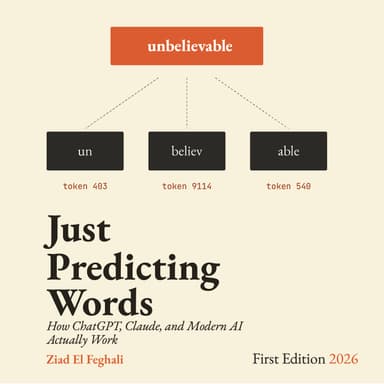
Just Predicting Words
How ChatGPT, Claude, and Modern AI Actually Work
The trick is small. The world it built is not.