When the person hired to ask hard questions leaves a company that fast, it is worth noticing. If you rely on any OpenAI product at work, the internal culture around risk and accountability is not a spectator sport for you.
Wednesday, August 12, 2026 · about a 2 minute read
The Invisible Hands Inside the Machine
Today's news keeps circling the same quiet question: who is actually watching what these models do, and how well do we understand what is happening inside them?
Get the calm version of AI news.
One email a day on what is actually happening in AI, in plain English. No hype, no doom.
Free. One calm email a day. No hype, no doom.
Researchers found that most biomedical papers now carry detectable signs of AI-assisted writing, which means the scientific literature your doctor's knowledge eventually rests on is quietly being shaped by autocomplete. That is not automatically bad, but it is worth knowing it is happening.
A new paper shows that the hidden chain-of-thought reasoning that companies like Anthropic and OpenAI keep private can be partially reconstructed just from watching the API outputs. The walls around those internal thought processes are thinner than advertised, which matters if you are building anything on top of these services.
Llama.cpp, the open-source tool that lets you run capable language models on your own laptop without a cloud subscription, hit the Hacker News front page with serious community interest. More people running AI locally means more people whose data never leaves their own machine.
Get this every morning.
You have probably heard that asking an AI to 'show its work' makes it smarter. This paper says that is only sometimes true. Think of it like asking someone to narrate every step while parallel parking: for simple tasks, the running commentary actually gets in the way. Knowing when to prompt for step-by-step reasoning and when to just ask directly will save you a lot of frustration.
A thoughtful engineer laid out a personal policy on when AI writing help is acceptable and when it quietly loses something that mattered. If your team does not have a written position on this yet, someone is making that call informally every day anyway.
A Fields Medal-winning mathematician sat down to map exactly where language models are genuinely useful in math versus where they confidently fall apart. If you have ever wondered whether AI can actually help with rigorous, precise thinking, this is the most credible voice yet to weigh in carefully.
That's today. See you tomorrow.
Get this every morning.
One email a day on what is actually happening in AI, in plain English. No hype, no doom.
Free. One calm email a day. No hype, no doom.

The book behind this newsletter
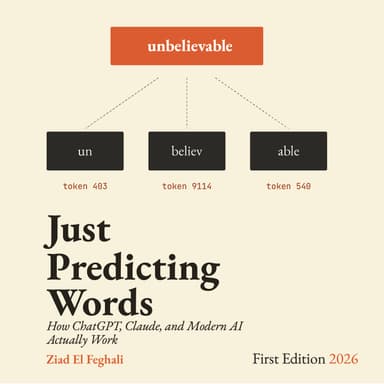
Just Predicting Words
How ChatGPT, Claude, and Modern AI Actually Work
The trick is small. The world it built is not.