The Next Token
est. 2026

Wednesday, June 3, 2026

Bots Beat Humans, Uber Pulls Back, and Your RAM Got More Expensive

A few things landed today that are worth a few minutes of your attention. No breakthroughs, no panic, just the slow machinery of AI working its way into ordinary life in ways you probably feel but haven't quite named yet. Grab something warm and let's go through it.

Hacker News
Bots have now passed human traffic online for the first time

For the first time, automated bot traffic has officially passed human traffic on the internet. Think of it like a highway where, one day, you look around and realize more than half the cars are delivery trucks with no drivers. The web was built for people, and now most of the knocking on its doors is machines talking to machines.

Read
Simon Willison
Uber Caps Usage of AI Tools Like Claude Code to Manage Costs

Uber started capping how much its engineers can use AI coding tools like Claude Code, because the bills got uncomfortably large. This is the part nobody puts in the press release: AI tools are genuinely useful, and genuinely expensive, and at some point the spreadsheet wins. It is a healthy reminder that 'transformative' and 'affordable' are two different questions.

Read
Hacker News
Gemma 4 12B: A unified, encoder-free multimodal model

Google released Gemma 4 12B, a smaller open model that handles text and images together without needing separate encoder components. Smaller open models that run on your own hardware matter because they shift the conversation from 'what can the cloud do for you' to 'what can you run yourself,' and that gap closing is a genuinely big deal for regular people.

Read
Hacker News
The Public Should Own Half of the Big A.I. Companies

Senator Bernie Sanders published an op-ed arguing the public should own half of the major AI companies, since public research dollars helped build the technology. You do not have to agree with the policy to recognize the underlying question, who benefits from AI and who paid to build it, is one that is going to get louder, not quieter.

Read

Get this every morning.

arXiv cs.CLResearch
The Deliberative Illusion: Diagnosing Factual Attrition and Stance Homogenization in Multi-Agent LLM Deliberation

Researchers found that when you put multiple AI agents in a room together to deliberate, they tend to agree with each other pretty quickly, and that agreement looks like confidence but is actually just conformity. Here is the analogy: imagine asking five friends for restaurant advice, but all five of them went to the same school, read the same blogs, and really hate conflict. They will reach consensus fast, and it will feel decisive, but you have not actually gotten five opinions. You have gotten one opinion wearing five hats. This matters because a lot of companies are betting that multi-agent systems are smarter than single models, and sometimes they are, but consensus among similar minds is not the same thing as correctness.

Read
Want the slow, plain-English version of why this matters? This is exactly the kind of idea the book was written to unpack, one light-switch analogy at a time.
JPWExplained properly in the book
arXiv cs.CLResearch
Memory Retrieval for Changing Preferences

A new research paper tackles a genuinely tricky problem: how should an AI decide when to reach into its memory, and which memories are still relevant given that people change their minds over time. Your preferences from six months ago are not always your preferences today, and building AI that understands that is harder than it sounds.

Read
Hacker News
A Post-Quantum Future for Let's Encrypt

Let's Encrypt, the nonprofit that handles security certificates for a huge chunk of the web, is planning for a post-quantum future. Quantum computers powerful enough to break today's encryption are not here yet, but the locks we put on the internet today need to last for decades, so this kind of quiet, unsexy preparation is exactly the right thing to be doing now.

Read
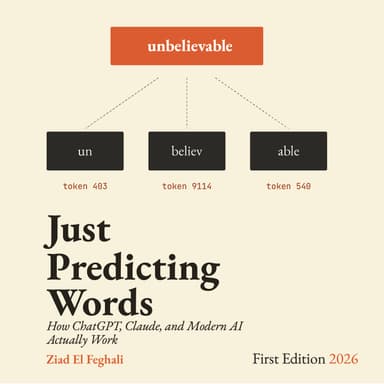
Just Predicting Words book cover

The book this grew from

Just Predicting Words

How ChatGPT, Claude, and Modern AI Actually Work

The trick is small. The world it built is not.