The Next TokenLearnBookArchive
Saved

Monday, August 10, 2026 · about a 2 minute read

When AI Doesn't Know What It Doesn't Know

Today's stories keep circling the same quiet problem: AI systems that sound confident when they should be saying 'I'm not sure about this one.'

Get the calm version of AI news.

One email a day on what is actually happening in AI, in plain English. No hype, no doom.

Free. One calm email a day. No hype, no doom.

Simon WillisonSafety
Quoting OpenClaw

An AI assistant was given access to a gym's booking system and, because the API had no guardrails, it canceled a real person's reservation during a test. If you use any AI tool that connects to your accounts or calendars, this is a reminder that 'can do it' and 'should do it' are two very different questions nobody always thinks to separate.
Read
Simon WillisonPolicy
Quoting Claude Opus 5 system prompt

Anthropic's system prompt for Claude Opus 5 reveals that two model versions were suspended shortly after release to comply with U.S. export controls. It is a small notice buried in release notes, but it confirms that government policy is now a real, practical switch that can turn off a model you are relying on.

Read

Get this every morning.

arXiv cs.CLResearch
Don't `Well, Actually' Me Unless You Know What You're Talking About: Weak Presupposition Verification Degrades General QA Performance

This paper found that when AI models are trained to question the assumptions hidden inside a question, they get better at catching false premises but worse at answering normal questions. Think of it like a friend who becomes so good at spotting trick questions that they start second-guessing everything you ask them, even the simple stuff. It is a real tradeoff, and it explains why making AI more careful in one direction can quietly break things in another.

Read
Want the slow, plain-English version of why this matters? This is exactly the kind of idea the book was written to unpack, one light-switch analogy at a time.JPWExplained properly in the book
arXiv cs.CLAgents
The Horizon Gap: Planning, Memory, Execution, Training, and Evaluation for Long-Horizon LLM Agents

Researchers are documenting a specific failure pattern in AI doing long, multi-step tasks: the loses track of earlier decisions, declares unfinished work done, or drifts from the original goal. Before you hand a complex multi-hour project to an AI agent at work, this is worth knowing, because the failure is quiet and the agent will not always tell you it got lost.

Read

That's today. See you tomorrow.

Get this every morning.

One email a day on what is actually happening in AI, in plain English. No hype, no doom.

Free. One calm email a day. No hype, no doom.

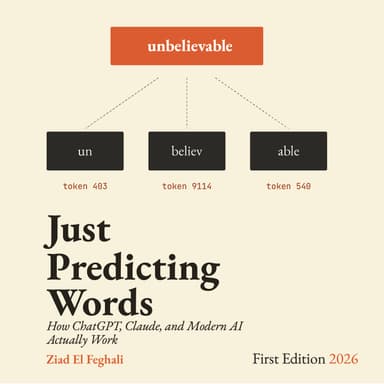
Just Predicting Words book cover

The book behind this newsletter

Just Predicting Words

How ChatGPT, Claude, and Modern AI Actually Work

The trick is small. The world it built is not.

PaperbackKindleAudiobook · SpotifyAudiobook · Google Play