A developer wrote up careful, honest notes about using AI coding tools in the field, including the rough spots where the tools loop, get confused, or need babysitting. If you use any AI coding assistant at work, this is the kind of ground-level reality check that saves you from over-trusting the tool on a deadline.
Saturday, July 4, 2026 · about a 2 minute read
AI Does the Coding, But Who Checks the Work
Today the news keeps circling back to the same quiet tension: AI is writing more and more of our code, and we are still figuring out what that means for the people who depend on it.
Get the calm version of AI news.
One email a day on what is actually happening in AI, in plain English. No hype, no doom.
Free. One calm email a day. No hype, no doom.
Researchers at Epoch AI noticed that reports of serious software vulnerabilities spiked right around the release of Claude Sonnet's preview, raising honest questions about whether more capable AI models are being used to find and exploit security holes faster. If your team ships software or depends on open-source libraries, the window between a vulnerability appearing and someone exploiting it may be getting shorter.
Josh Comeau, a well-regarded web developer who sells online courses, says his latest launch sold about one-third of what a normal launch used to, and his existing courses are down too. He suspects AI tools are replacing the need people used to have for certain tutorials, which is a concrete signal for anyone who teaches, writes, or sells expertise online.
A new non-profit called Current AI launched an open map showing where open-source AI is strong and where it still has big gaps compared to closed commercial models. If you or your organization care about not being locked into one vendor, this is a useful honest picture of how far the open alternatives actually go today.
Get this every morning.
Researchers found that the way you word a question to an AI can dramatically change its error-detection score, without the AI actually getting any better at finding errors. Think of it like a multiple-choice test where changing the answer choices makes a student look smarter even though they learned nothing new. This matters because a lot of decisions about which AI tool to trust are based on scores that can be gamed just by tweaking the prompt.
A community challenge asked researchers to build the best possible language model under a strict size budget, like baking the best cake with only a cup of flour. The results are showing which training tricks actually hold up and which ones are just expensive noise, and that knowledge will eventually make its way into the smaller, faster models that run on ordinary hardware.
That's today. See you tomorrow.
Get this every morning.
One email a day on what is actually happening in AI, in plain English. No hype, no doom.
Free. One calm email a day. No hype, no doom.

The book behind this newsletter
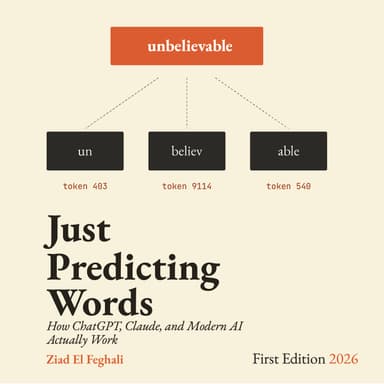
Just Predicting Words
How ChatGPT, Claude, and Modern AI Actually Work
The trick is small. The world it built is not.