When the model reads your text, it does not see whole words, it sees chunks called . Slightly misspell a sensitive word and those chunks change, and the model's safety training simply does not recognize the threat anymore. If your company uses an AI tool for customer-facing content, this is a reminder that 'we have safety filters' is not the same as 'we are protected.'
Friday, July 3, 2026 · about a 2 minute read
Safety Has a Spelling Problem
Today's research keeps circling the same quiet worry: the AI systems we rely on are more fragile at the edges than they look from the center.
Get the calm version of AI news.
One email a day on what is actually happening in AI, in plain English. No hype, no doom.
Free. One calm email a day. No hype, no doom.
Researchers found that two completely harmless images, when shown together to a AI, can produce harmful outputs that neither image would trigger alone. This matters if you are building or approving any AI tool that accepts more than one image at a time, because your content filters were probably only tested on images one by one.
HaloGuard is an open, freely available safety-classifier model that beats much larger commercial alternatives on filtering unsafe prompts, in multiple languages, at about one-tenth the computing cost. For anyone building an AI-powered product on a real budget, this is the kind of news worth bookmarking.
Reasoning models often keep second-guessing themselves long after they have a good answer, burning time and money on extra that do not improve the result. This paper shows those habits are baked in by training, not just random noise, which means they can be trained away. Your AI assistant spending five paragraphs to answer a yes-or-no question is not being thorough; it is being inefficient.
FaithMed is a new approach to training medical AI that forces the model to show its reasoning and anchor every claim to actual clinical evidence. If you have ever worried about whether to trust an AI health summary, this kind of work is exactly what has to exist before that trust is warranted.
Get this every morning.
TokenScope is a tool that shows you, by token, how a large language model decides what code to write next. That is a good hook to explain something the book covers: the model is not reasoning like a programmer, it is picking the next most likely piece based on everything it has seen. TokenScope makes that visible, and seeing it changes how you interpret what the model produces. Next time an AI writes you a function, remember you are looking at a very confident autocomplete, not a colleague who tested it.
Simon Willison shares a framing from a conference talk: 'understand to participate.' The idea is that as AI do more of our work, the people who stay in control are the ones who understand what the is actually doing, not just what it says it is doing. This is not about learning to code; it is about not outsourcing your judgment along with your task.
That's today. See you tomorrow.
Get this every morning.
One email a day on what is actually happening in AI, in plain English. No hype, no doom.
Free. One calm email a day. No hype, no doom.

The book behind this newsletter
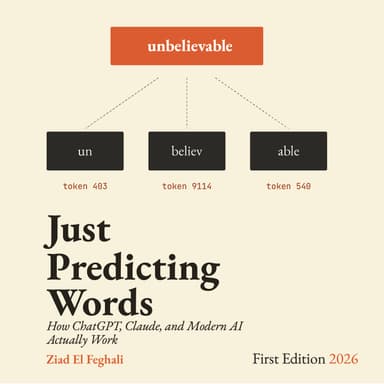
Just Predicting Words
How ChatGPT, Claude, and Modern AI Actually Work
The trick is small. The world it built is not.