The Next TokenLearnBookArchive
Saved

Wednesday, July 1, 2026 · about a 2 minute read

Trust, Tools, and a New Model in the Room

Today's AI news keeps circling the same quiet question: when do you actually trust the output, and when do you just assume it's fine?

Get the calm version of AI news.

One email a day on what is actually happening in AI, in plain English. No hype, no doom.

Free. One calm email a day. No hype, no doom.

Hacker NewsModels
Claude Sonnet 5

Claude Sonnet 5 is Anthropic's new mid-tier model, and with over a thousand upvotes on Hacker News it's clearly the thing people are actually talking about today. If you use Claude at work or through any app built on it, you're likely already on a path to seeing different, and reportedly better, results without changing anything you do.
Read
Hacker NewsBusiness
Claude Science

Anthropic also launched Claude Science, a dedicated product aimed at research workflows, on the same day as Sonnet 5. Whether this becomes a genuine tool for scientists or mostly a branding move is worth watching, but it signals that AI labs are now competing on specialized audiences, not just raw capability.

Read
Hacker NewsPolicy
Godot will no longer accept AI-authored code contributions

The Godot game engine, which is free and built by volunteers, announced it will no longer accept code contributions that were written by AI, because maintainers say they can't trust that the contributor actually understands what they submitted. If you work on any open-source project, this is a real policy conversation coming your way soon.

Read
Simon WillisonPolicy
Quoting Anthropic

The U.S. Department of Commerce lifted export controls on two Anthropic models, Claude Fable 5 and Mythos 5, meaning those models can now be accessed in countries that were previously blocked. This is a small bureaucratic update with a concrete effect: teams in restricted regions can now build with those tools legally.

Read

Get this every morning.

arXiv cs.CLSafety
When the Database Fails: Prompting LLM Dialogue Agents for Safe Recovery in Task-Oriented Dialogue

Researchers found that AI assistants used for booking or customer service tasks will confidently invent fake confirmations, venues, or details when the real database comes back empty, rather than simply saying they don't know. Think of it like a friend who was supposed to look up the restaurant reservation but just made up an address so they didn't look unhelpful. The lesson is that fluency and accuracy are completely separate things, and a model that sounds certain is not the same as a model that is correct.

Read
Want the slow, plain-English version of why this matters? This is exactly the kind of idea the book was written to unpack, one light-switch analogy at a time.JPWExplained properly in the book
arXiv cs.CLResearch
Can LLMs Imagine Moral Alternatives Beyond Binary Dilemmas?

Researchers tested whether large language models can think past a binary either/or moral dilemma and imagine a third option, the way a thoughtful person might. Most models struggled. This matters practically because people are already using these tools for advice, and advice that only sees two choices is often the worst kind.

Read
Simon WillisonTools
The AI Compass

Someone built a political-compass-style quiz specifically about AI and AI ethics, and it's a genuinely interesting way to figure out where you actually stand rather than where you assume you do. Takes a few minutes and is more honest than most AI opinion pieces.

Read

That's today. See you tomorrow.

Get this every morning.

One email a day on what is actually happening in AI, in plain English. No hype, no doom.

Free. One calm email a day. No hype, no doom.

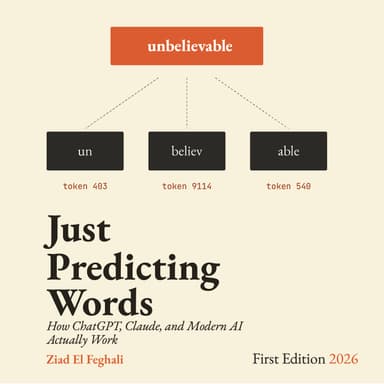
Just Predicting Words book cover

The book behind this newsletter

Just Predicting Words

How ChatGPT, Claude, and Modern AI Actually Work

The trick is small. The world it built is not.

PaperbackKindleAudiobook · SpotifyAudiobook · Google Play