Qwen 3.6 27B is a model you can run on a decent laptop or a modest cloud instance, and the Hacker News community is loudly agreeing it punches well above its weight for everyday coding and reasoning tasks. If you have been waiting for a capable local model that does not require a small datacenter, the wait is getting shorter.
Tuesday, June 30, 2026 · about a 2 minute read
Smaller, Cheaper, and Still Pretty Good
Today the news keeps circling back to the same quiet tension: the AI industry built itself on the assumption that bigger always means better, and that assumption is getting stress-tested from several directions at once.
Get the calm version of AI news.
One email a day on what is actually happening in AI, in plain English. No hype, no doom.
Free. One calm email a day. No hype, no doom.
Moondream, a small AI company, published a sharp argument that prices are inflated by speculation and fear-of-missing-out procurement, not by actual demand. If they are right, the cost of building and running AI products could drop significantly over the next year or two, which changes the math for a lot of businesses.
Researchers audited fourteen major LLMs on resume screening and found that several reproduce the same pro-White callback bias documented in real-world hiring studies. If your company is using an AI tool anywhere near a hiring pipeline, this is the kind of finding that belongs in front of your HR and legal teams today, not later.
A new study looks at how calling AI systems things like 'thinks,' 'understands,' or 'feels' shapes what ordinary people expect from them, and not always in accurate directions. The words journalists and marketers choose about AI are quietly setting expectations that the technology then has to live up to, or disappoint.
Researchers found that LLMs internally represent how strong a piece of clinical evidence is, even when the model's own stated answer does not reflect that knowledge. Think of it like a friend who secretly knows the right answer but gives you a wishy-washy response anyway. This gap between what a model 'knows' and what it says is a real problem for anyone relying on AI summaries of medical research.
Get this every morning.
This paper argues that 'machine unlearning,' the idea that you can make an AI model forget specific information after training, is mostly a fiction in current LLMs. Think of training like baking a cake: you cannot pull the eggs back out once it is baked. Understanding this helps explain why 'just delete that data' is not a simple fix for privacy or copyright concerns, and why the legal and technical worlds are talking past each other on this issue.
Ornith-1.0 is a small new open-weights model that essentially writes and runs its own scaffolding code to complete tasks, a step toward that need less hand-holding from human engineers. It is early and from a new lab, but the MIT license means anyone can pick it up and experiment.
That's today. See you tomorrow.
Get this every morning.
One email a day on what is actually happening in AI, in plain English. No hype, no doom.
Free. One calm email a day. No hype, no doom.

The book behind this newsletter
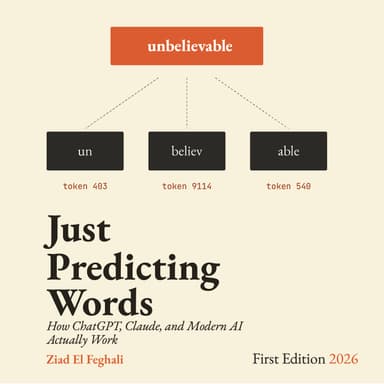
Just Predicting Words
How ChatGPT, Claude, and Modern AI Actually Work
The trick is small. The world it built is not.