Think of it like a company car that costs more in gas and maintenance than the driver earns. A new analysis argues that by 2029, AI spending at many companies will exceed what they would have paid a human to do the same work, which means the ROI math that made AI a no-brainer is going to get a lot harder to defend.
Monday, July 6, 2026 · about a 1 minute read
AI Gets Expensive, Smarter, and Surprisingly Good at Teaching
Today's stories share a quiet question underneath all the announcements: what happens when AI starts costing more than it saves, or doing more than we expected?
Get the calm version of AI news.
One email a day on what is actually happening in AI, in plain English. No hype, no doom.
Free. One calm email a day. No hype, no doom.
OpenAI is slotting a newer, more powerful model called GPT-5.6 Sol Ultra into Codex, its AI coding tool, which means developers using Codex in their daily workflow are about to get a noticeably more capable assistant without doing anything differently.
Get this every morning.
An effect size of 0.71 to 1.30 standard deviations sounds like a statistics class gone wrong, but here is what it means in plain terms: students who used this AI tutor in a real Dartmouth course learned roughly as much in less time as students who had a personal human tutor. That is the researchers have chased for decades. The reason this connects to how AI actually works is that the model is not teaching in any deep sense. It is responding to what you write, predicting what a helpful explanation would look like next. The wild part is that for learning, that turns out to be enough.
That's today. See you tomorrow.
Get this every morning.
One email a day on what is actually happening in AI, in plain English. No hype, no doom.
Free. One calm email a day. No hype, no doom.

The book behind this newsletter
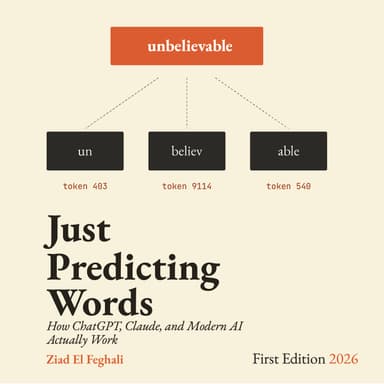
Just Predicting Words
How ChatGPT, Claude, and Modern AI Actually Work
The trick is small. The world it built is not.