Researchers found that LLMs can sound very confident even when they are basically guessing, depending on how you phrase the question. If you are using an AI tool to help make decisions at work, that confident tone is not a guarantee of accuracy, it is just a tone.
Saturday, June 20, 2026 · about a 2 minute read
AI Gets Better at Knowing What It Does Not Know
A quiet theme running through today's news: the field is slowly getting more honest, about what models understand, where they fail, and who gets to decide.
Get the calm version of AI news.
One email a day on what is actually happening in AI, in plain English. No hype, no doom.
Free. One calm email a day. No hype, no doom.
When you hook an up to a knowledge graph (a structured map of facts and how they connect), it can still , inventing plausible-sounding links that do not exist. Any product using AI to surface recommendations or draw conclusions from connected data carries this risk quietly inside it.
A new paper asks whether LLMs can genuinely help with democratic deliberation, public consultation, policy feedback, that kind of thing, or whether they mostly flatten nuance and favor whoever writes the best prompt. If your city or employer starts using AI to gather public input, this question matters more than it sounds.
When multiple AI work together in a chain, errors compound in ways a single retry cannot fix. This new protocol tries to tell the difference between an answer that is incomplete and one that is just flat wrong, so the system can respond appropriately instead of confidently recycling bad output.
Get this every morning.
Researchers discovered that single neurons inside a language model can act like little gatekeepers, controlling specific behaviors like refusing a request or switching languages. But flipping one neuron does not always do what you expect, sometimes it just breaks the output entirely. This is why 'steering' a model is harder than it looks from the outside, and why is not a simple dial you turn up.
It turns out LLMs can communicate meaning to each other using compressed, non-human-readable text, skipping the natural language we use to talk to them. This is early research, but it hints at a future where AI systems talk to each other in ways we cannot easily read or audit.
MCP, the protocol that lets AI connect to outside tools and services, is getting sharper because it handles login and authentication outside the model's view. That matters because it means the does not need to see your credentials to use them, which is a small design choice with real security consequences.
That's today. See you tomorrow.
Get this every morning.
One email a day on what is actually happening in AI, in plain English. No hype, no doom.
Free. One calm email a day. No hype, no doom.

The book behind this newsletter
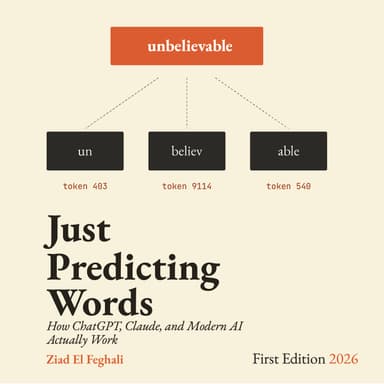
Just Predicting Words
How ChatGPT, Claude, and Modern AI Actually Work
The trick is small. The world it built is not.