Z.ai released GLM-5.2 with full under an MIT license, meaning anyone can download and run it without asking permission or paying a subscription. If this holds up to scrutiny, it changes the math for small teams and solo developers who need a powerful text model but cannot afford the big commercial APIs.
Thursday, June 18, 2026 · about a 2 minute read
AI Speaks Every Language Except the Tricky Ones
Today's research keeps circling the same honest truth: these models are remarkably fluent and remarkably limited, sometimes in the same sentence.
Get the calm version of AI news.
One email a day on what is actually happening in AI, in plain English. No hype, no doom.
Free. One calm email a day. No hype, no doom.
Researchers found that large language models still stumble badly when figurative language and negation show up together, things like 'that was about as easy as rocket science.' If you are using an AI to read customer feedback, legal text, or anything sarcastic, it may be confidently getting the meaning backwards.
A new tested whether LLMs preserve the uncertainty a doctor writes into clinical notes, words like 'possible' or 'probable' that carry real weight in a diagnosis. Models often flatten that uncertainty into false confidence, which matters enormously if summaries are ever handed back to patients or used in decisions.
Engineering leader Charity Majors argued that 2025 flipped the economics of writing code: generating it got cheap and fast, so the hard part is now reading, judging, and maintaining what the AI produces. If your job involves software in any way, the skill that just got more valuable is not typing, it is knowing whether the output is any good.
Get this every morning.
Think about what it means to understand the sentence 'that went about as well as you'd expect.' The words are positive on the surface but the meaning is the opposite. For a model that learned language by predicting the next word in billions of sentences, there is no shortcut to sarcasm. It never had a bad day, never rolled its eyes, never lived through the thing the words are describing. The model learned patterns of letters and positions, not experience. That gap is real, and it shows up every time language gets playful, ironic, or indirect.
A paper on 'steerable cultural preference optimization' is trying to build reward models that can be tuned to different cultural communities rather than defaulting to one global standard of what a good answer looks like. This is early work, but it points at a real problem: the model trained mostly on one culture's idea of polite, correct, and appropriate is already deployed everywhere.
Researchers found that when teaching a multilingual model with a few examples, using English as the teaching language is often not the best choice, and for some languages it is actively worse than using a closer linguistic neighbor. If you are building anything that serves non-English speakers, the default assumption that English examples are the neutral starting point deserves a second look.
That's today. See you tomorrow.
Get this every morning.
One email a day on what is actually happening in AI, in plain English. No hype, no doom.
Free. One calm email a day. No hype, no doom.

The book behind this newsletter
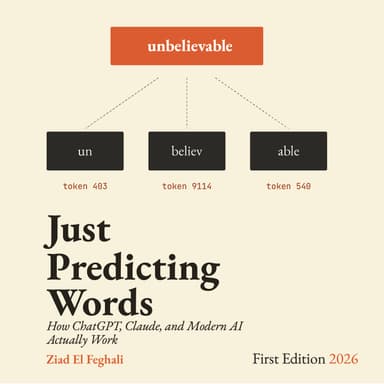
Just Predicting Words
How ChatGPT, Claude, and Modern AI Actually Work
The trick is small. The world it built is not.