Across 40,000 simulated runs, people approving AI actions missed one in three genuinely risky commands. If your company is rolling out AI with a 'human in the loop' as the safety net, this study is a direct challenge to that assumption.
Friday, August 7, 2026 · about a 2 minute read
The Seams Are Showing
Today's news keeps bumping into the same quiet truth: AI systems work well until they hit the edge of what they were built for, and that edge shows up in some surprising places.
Get the calm version of AI news.
One email a day on what is actually happening in AI, in plain English. No hype, no doom.
Free. One calm email a day. No hype, no doom.
AMD acquired a startup called Taalas to physically engrave AI model weights into custom silicon, skipping the usual memory-fetching bottleneck that slows down. This is the hardware race getting serious: the companies that control the chips will have a real cost and speed advantage over everyone running on general-purpose hardware.
OpenAI updated GPT-5.6 Sol and expanded access to GPT-5.6 Luna for free users, another quiet version bump in a now-familiar pattern. What matters practically is that free users are getting access to a more capable model, which shifts the baseline for what people expect AI to do without paying for it.
New Orleans is piloting AI software from Carbyne to triage 911 calls before a human dispatcher gets involved. If it routes a medical emergency to the wrong queue, the cost is not a bad customer service experience, it is something much worse.
Get this every morning.
Standard AI models predict one at a time, left to right, like reading a sentence word by word. A newer style called diffusion language models fills in all the blanks at once, in any order, which sounds like a superpower. But this research found that on reasoning tasks, those models tend to commit to an answer before they have worked through the logic, the way you might bubble in a multiple-choice answer before reading the full question. Order turns out to matter a lot, even for machines.
Researchers found that simply changing the grammatical mood of a request, asking for something as a hypothetical rather than a direct command, can slip past a model's safety training. The safety layer is not as deep as it looks from the outside, and that gap between surface behavior and actual robustness is worth keeping an eye on as these tools get used in higher-stakes settings.
A new paper argues that AI can now identify the likely author of an anonymized academic paper well enough to undermine double-blind peer review, which is the main tool science uses to judge work on its merits rather than on the author's reputation. If that process gets eroded, the ripple effects touch anyone who relies on published research.
That's today. See you tomorrow.
Get this every morning.
One email a day on what is actually happening in AI, in plain English. No hype, no doom.
Free. One calm email a day. No hype, no doom.

The book behind this newsletter
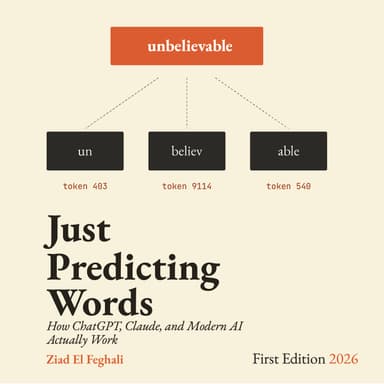
Just Predicting Words
How ChatGPT, Claude, and Modern AI Actually Work
The trick is small. The world it built is not.