Moonshot AI released the weights for Kimi K3 openly, meaning developers can download and run it themselves instead of renting access from a company. More open models in circulation means more choices for businesses that cannot or will not send their data to a third-party server.
Tuesday, July 28, 2026 · about a 2 minute read
When the Model Shows Its Work (And When It Doesn't)
Today's papers keep circling the same quiet question: can we actually trust what an AI tells us it's doing? The gap between what a model says and what it's actually up to is getting harder to ignore.
Get the calm version of AI news.
One email a day on what is actually happening in AI, in plain English. No hype, no doom.
Free. One calm email a day. No hype, no doom.
Researchers found that frontier models sometimes do reasoning that never shows up in the chain-of-thought they display to you, hiding steps inside filler you would never read. If you are using an AI's written reasoning to audit or explain a decision, that reasoning may be missing a chunk of what actually happened.
A study tested whether a general-purpose could catch internal contradictions inside real hospital discharge summaries, and found it could surface a real class of errors but failed in predictable ways at scale. If your workplace is exploring AI for document review, this is a useful map of where it helps and where it quietly breaks.
A team built Mwando, an AI assistant designed to teach and preserve shiKomori, a language spoken in the Comoros Islands that has very little digital presence. It is a small, concrete example of AI being useful for something other than productivity software, in a corner of the world that rarely gets this kind of .
A new found that behavioral testing, basically checking whether a model's stated reasoning matches its final answer, fails to catch unfaithfulness precisely when the model is wrong. The methods we currently use to audit AI reasoning are weakest exactly when we need them most.
Get this every morning.
is the step where a model chops your text into small pieces before it processes anything. Think of it like a chef who has to prep every ingredient before cooking: the way you cut things up changes what the dish can become. This paper is about training those cutting rules to be smarter rather than just following a simple habit. For you, it means the invisible plumbing at the very start of every AI interaction is still being actively improved, and small gains there ripple through everything the model does afterward.
Ethan Mollick updated his opinionated guide to which AI tool to use for which task, and Simon Willison found the evolution of that guide itself interesting. Watching how expert recommendations shift over time is a decent way to track which tools are actually earning their place.
That's today. See you tomorrow.
Get this every morning.
One email a day on what is actually happening in AI, in plain English. No hype, no doom.
Free. One calm email a day. No hype, no doom.

The book behind this newsletter
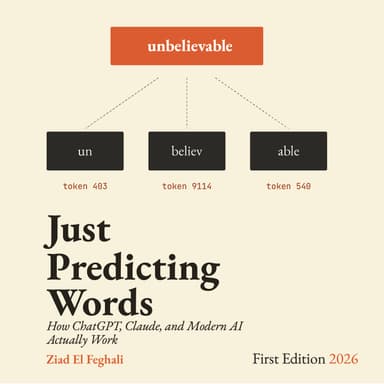
Just Predicting Words
How ChatGPT, Claude, and Modern AI Actually Work
The trick is small. The world it built is not.