The Next TokenLearnBookArchive
Saved

Monday, June 22, 2026 · about a 2 minute read

Who Are You, Really

Today the question underneath a lot of AI news is trust: who is using these tools, and how much should the tools take their word for it.

Get the calm version of AI news.

One email a day on what is actually happening in AI, in plain English. No hype, no doom.

Free. One calm email a day. No hype, no doom.

Hacker NewsSafety
Identity verification on Claude

Anthropic is testing a way for Claude users to verify who they are, which would let the model treat a verified nurse asking about medication doses differently than an anonymous stranger asking the same question. This matters to you because it is the first time a major AI lab is trying to solve the 'but who is actually asking?' problem in a systematic way, which affects how useful, or how locked-down, these tools feel in your professional life.
Read
Hacker NewsModels
Apertus – Open Foundation Model for Sovereign AI

A project called Apertus launched an open foundation model aimed at governments and organizations that want to run AI without depending on American tech companies. If you work in a country, a company, or an industry where data sovereignty is a real concern, this is the kind of option that could eventually matter to your procurement decisions.

Read
Hacker NewsTools
Good results fine tuning a local LLM like Qwen 3:0.6B to categorize questions

Someone fine-tuned a tiny local model, Qwen at just 0.6 billion , to sort questions into categories, and it worked well enough to impress a lot of people. The practical takeaway is that you do not always need a massive cloud-based model to do something useful, which has real implications for cost, privacy, and what you can run on your own hardware.

Read

Get this every morning.

Hacker NewsResearch
Good results fine tuning a local LLM like Qwen 3:0.6B to categorize questions

is like taking a well-read generalist and giving them a focused apprenticeship in one specific job. The base model already knows language, reasoning, and a lot about the world. Fine-tuning just says: here are a few thousand examples of exactly the task I care about, now get good at that specific thing. The reason the Qwen story is interesting is that it shows how small the model can be and still do the focused job well, because you are not asking it to know everything anymore, just one thing.

Read
Want the slow, plain-English version of why this matters? This is exactly the kind of idea the book was written to unpack, one light-switch analogy at a time.JPWExplained properly in the book
Simon WillisonTools
sqlite-utils 4.0rc1 adds migrations and nested transactions

Simon Willison shipped a new version of sqlite-utils with better support for database migrations, which is a small tool update but a signal worth noting: the serious AI builders are investing heavily in the unglamorous plumbing that makes data manageable. If you ever want to build something on top of a local model, clean data tooling is usually the part that trips you up first.

Read

That's today. See you tomorrow.

Get this every morning.

One email a day on what is actually happening in AI, in plain English. No hype, no doom.

Free. One calm email a day. No hype, no doom.

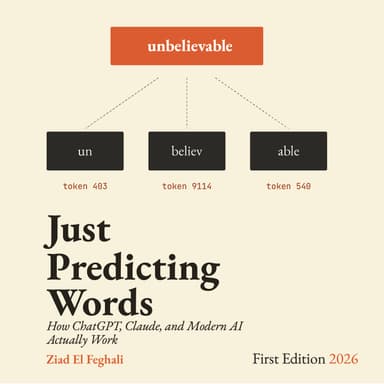
Just Predicting Words book cover

The book behind this newsletter

Just Predicting Words

How ChatGPT, Claude, and Modern AI Actually Work

The trick is small. The world it built is not.

PaperbackKindleAudiobook · SpotifyAudiobook · Google Play