DeepSeek, the Chinese lab that surprised everyone earlier this year, now has a model that beats OpenAI's latest on at least one precision . If you assumed the frontier was a two-horse race between OpenAI and Anthropic, this is a good reminder to look up.
Monday, June 8, 2026 · about a 2 minute read
The Gap Between What AI Knows and What It Does
Today's news keeps circling the same honest question: AI systems carry a lot of capability, but getting that capability to show up reliably, in the right language, for the right person, at the right moment, is still genuinely hard work.
Get the calm version of AI news.
One email a day on what is actually happening in AI, in plain English. No hype, no doom.
Free. One calm email a day. No hype, no doom.
Researchers found that LLMs trained mostly on English know plenty of facts but often can't recall those same facts when you ask in French, Swahili, or Korean. If your team uses AI tools in any language other than English, you're probably getting a quieter, less knowledgeable version of the model without realizing it.
A writer followed up on their earlier post about LLMs slowly eroding their freelance career, responding to reader pushback. It's a small post with a real conversation attached, and it's one of the more grounded accounts of what job-level AI friction actually feels like from inside it.
A new framework called IDPR tries to teach models when to slow down and think carefully versus when to just answer quickly. Think of it like a person who knows not to reach for a calculator to figure out what two plus two is. That kind of self-awareness saves real computing costs, which eventually affects what these tools cost you.
Get this every morning.
Researchers looked at exactly where in a model's output reasoning starts to go wrong, and found two distinct failure patterns with different fingerprints. This matters because it means not all AI mistakes are the same kind of mistake, and fixing one type won't fix the other. Next time a model confidently hands you something wrong, there's a real mechanism behind that, not just randomness.
Most AI personalization research uses fake, synthetic users to test whether models adapt to individual people. This paper looked at real users and found the gap between lab performance and actual performance is significant. If a product promises it will learn your preferences, it's worth knowing that promise is much easier to make in a lab than in the wild.
A study mapped out what people actually want from AI assistants and found that preferences conflict a lot, and that the standard training method used to align models tends to paper over those conflicts rather than resolve them. Worth watching because whoever figures out how to handle genuine preference disagreement will build something meaningfully more useful than what exists today.
That's today. See you tomorrow.
Get this every morning.
One email a day on what is actually happening in AI, in plain English. No hype, no doom.
Free. One calm email a day. No hype, no doom.

The book behind this newsletter
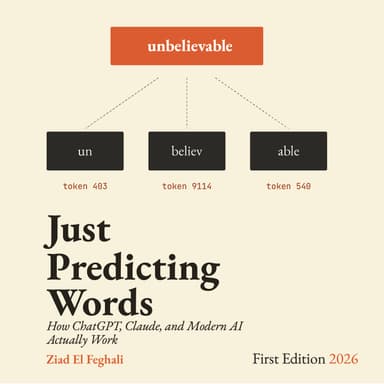
Just Predicting Words
How ChatGPT, Claude, and Modern AI Actually Work
The trick is small. The world it built is not.