The S&P 500 has a simple rule: you need to be profitable for four straight quarters to join the club. OpenAI and Anthropic do not qualify, which means the companies building the tools you use every day are still spending far more than they earn. That is worth keeping in mind the next time pricing changes or a free tier disappears.
Saturday, June 6, 2026 · about a 2 minute read
The Gap Between Buzz and Books
Today's news keeps bumping into the same quiet tension: AI is everywhere in the conversation, but the actual track record is still being written, and people are starting to keep score.
Get the calm version of AI news.
One email a day on what is actually happening in AI, in plain English. No hype, no doom.
Free. One calm email a day. No hype, no doom.
A developer ran a careful analysis of the rsync codebase and found evidence that AI-assisted contributions correlated with more bugs, not fewer. If you are using AI tools to write or review code at work, this is a concrete reminder that the output still needs a real human looking at it, not just a quick skim.
Google employees are apparently sharing internal memes about their own AI products being bad, and a reporter caught it. When the people building the thing are the ones making jokes about it, that tells you something honest about where the technology actually stands right now.
OpenAI quietly launched Lockdown Mode, a setting that lets you restrict what ChatGPT can share or do with your data. It is a small toggle, but it is the kind of control users have been asking for, and it signals that safety features are slowly becoming a real product category, not just a footnote in terms of service.
Someone asked Hacker News why the tech community there seems so skeptical of AI, and the thread got 175 upvotes and a genuinely interesting conversation. The short answer seems to be that experienced engineers are the ones closest to the real failure modes, and proximity tends to replace enthusiasm with caution.
Get this every morning.
Researchers built a model that tracks how people change their minds during a conversation, not just before and after. Think of it like watching a weather map instead of comparing two snapshots: you get to see the actual moment the wind shifts. This matters because it helps reveal whether an AI is genuinely helping someone think, or just nudging them toward agreement, which are very different things for anyone using AI as a research or decision tool.
The Ladybird browser project announced it will no longer accept public pull requests, partly because a large commit used to signal genuine effort, and now it does not. This is a small policy change in one open-source project, but it points at a real question that every collaborative software team will face: how do you maintain trust in contributions when effort is no longer a reliable signal of good faith.
That's today. See you tomorrow.
Get this every morning.
One email a day on what is actually happening in AI, in plain English. No hype, no doom.
Free. One calm email a day. No hype, no doom.

The book behind this newsletter
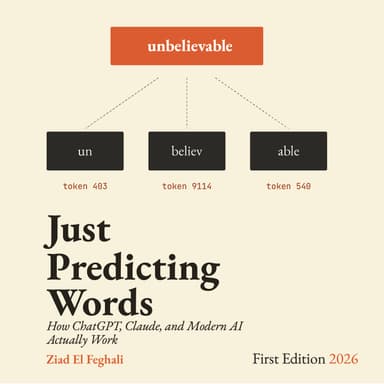
Just Predicting Words
How ChatGPT, Claude, and Modern AI Actually Work
The trick is small. The world it built is not.