Ted Chiang, one of the clearest thinkers writing about AI right now, argues that large language models are not conscious, full stop. It is worth reading because he makes the case carefully, without either dismissing AI or inflating it into something mystical.
Thursday, June 4, 2026 · about a 2 minute read
AI Judges Itself, and the Verdict Is Complicated
A few quiet but important things landed today. No world-ending announcements, no breathless launches. Just some honest research and a couple of tools worth knowing about.
Get the calm version of AI news.
One email a day on what is actually happening in AI, in plain English. No hype, no doom.
Free. One calm email a day. No hype, no doom.
Researchers found that when you use one AI model to judge the output of another AI model, the two models tend to agree with each other a lot but agree with actual humans much less. Think of it like asking your coworker to grade your own work, when you both went to the same school, read the same textbooks, and picked up the same blind spots.
A new study shows that even the topic you bring up in a conversation can nudge an toward treating you differently, as if it has guessed who you are from context clues. In high-stakes situations like medical or legal questions, that subtle shift in tone or advice is not a small thing.
Meta is allowing employees to opt out of workplace tracking for up to 30 minutes at a time. The fact that opting out requires an active choice, and only lasts half an hour, tells you quite a bit about how these systems are designed by default.
A developer released Mnemo, a local memory layer you can plug into any so it actually remembers things across conversations, stored on your own machine, not in the cloud. It is early and scrappy, but the idea of giving a model persistent memory without handing that memory to a company is worth paying to.
Get this every morning.
This paper is about hallucinations, which is when an AI confidently states something that is simply wrong. The researchers describe hallucinations as a kind of noise that points in the wrong direction from what the context actually supports. Imagine you are following directions to a coffee shop, and your brain confidently inserts a turn that was never on the map. The model is not lying, it is just predicting the next word, and sometimes the next word it picks is one that sounds right but leads nowhere real.
Apple apparently doubled production of the MacBook Neo because demand is so high. The reason this matters for AI is simple: more powerful personal chips mean more people can run smaller AI models locally, on their own hardware, without sending data anywhere.
Researchers tested whether LLMs lean toward pro-environmental positions on sustainability questions, and the answer is largely yes, which raises a fair question about how much those outputs reflect genuine analysis versus patterns baked in during training.
That's today. See you tomorrow.
Get this every morning.
One email a day on what is actually happening in AI, in plain English. No hype, no doom.
Free. One calm email a day. No hype, no doom.

The book behind this newsletter
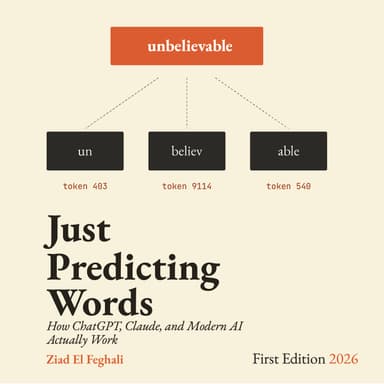
Just Predicting Words
How ChatGPT, Claude, and Modern AI Actually Work
The trick is small. The world it built is not.